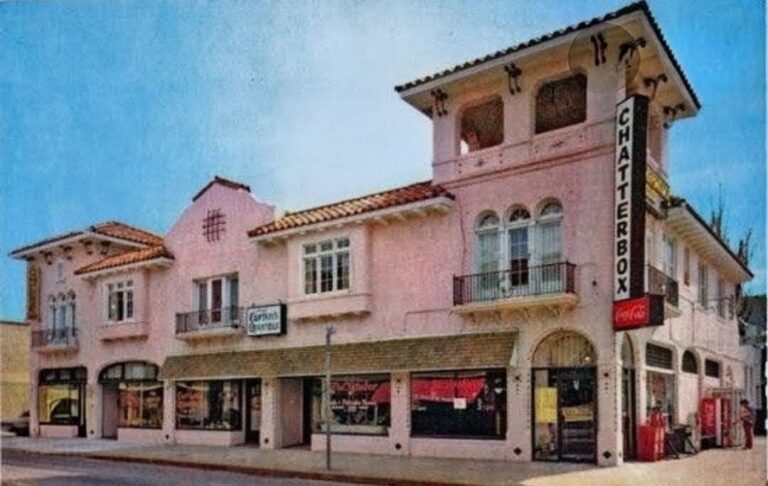
The Flanders Hotel: Prohibition, Ghosts, and My Years Behind the Scenes
Flanders Hotel Ocean City has always been more than just another historic hotel along the Ocean City, New Jersey Boardwalk. Since opening in 1923, the Flanders has witnessed Prohibition, devastating fires, famous visitors, financial struggles, and more than a century of change. Hidden beneath its grand architecture are stories of secret speakeasies, underground Catacombs, and a mysterious ghost known as Emily, the Lady in White.
My connection to the Flanders Hotel is a little more personal. I once worked there as a banquet waiter, first during the Kirkman years and later when James Dwyer became involved with the property. I helped set up the Portal Bar, worked banquets, and eventually managed a restaurant near the rides. At the time, it was simply another job. Looking back, I realize I was working inside one of Ocean City’s most fascinating historic landmarks.
I have a slightly different connection to the Flanders. I once worked there.
During my years in Ocean City, I worked as a banquet waiter at the Flanders, first during the Kirkman era and later when James Dwyer became involved with the property. I helped set up what we called the Portal Bar, worked banquets, and eventually managed a restaurant near the rides.
Like most jobs when you’re younger, I probably didn’t appreciate the history surrounding me. It was simply a place where I went to work. The ballrooms needed setting up, guests needed serving, and there was always something that needed to be done.
But the Flanders wasn’t an ordinary workplace. Behind the banquet rooms and public corridors were decades of stories, some documented, others passed from one generation of employees to the next.
And occasionally, I got to see parts of the building that most visitors probably never knew existed.
The Flanders Hotel: A Grand Beginning in 1923
The Flanders Hotel opened on July 23, 1923, at a time when Ocean City was trying to establish itself as one of the premier family vacation destinations along the Jersey Shore.
A group of local businessmen formed the Ocean Front Hotel Corporation to finance an ambitious project. They wanted something that could compete with the magnificent hotels of Atlantic City, something that would bring wealthy vacationers and national attention to Ocean City.
The result was a $1.5 million hotel designed by local architect Vivian B. Smith.
With 232 rooms, elegant ballrooms, dining facilities, shops, and an oceanfront location, the Flanders was unlike anything else in town. Built with steel girders and concrete, it was advertised as fireproof, a distinction that would prove remarkably important just a few years later.
The name itself came from the battlefields of Flanders, Belgium, where so many Allied soldiers lost their lives during World War I. Images of poppies, symbols of remembrance, decorated the hotel’s grand opening celebration.
It was supposed to represent a new era for Ocean City.
And in many ways, it did.
A Hotel That Survived the Great Boardwalk Fire
In October 1927, a massive fire devastated Ocean City’s Boardwalk, destroying hotels, businesses, and hundreds of guest accommodations.
The Flanders survived.
Its steel-and-concrete construction protected it while much of the surrounding Boardwalk burned. When the city rebuilt the Boardwalk farther toward the ocean, the hotel suddenly found itself separated from the main promenade.
Rather than surrender its prime location, the owners built an extension connecting the hotel to the rebuilt Boardwalk.
That additional space would eventually become home to one of Ocean City’s most popular attractions: the Flanders saltwater swimming pools.
Looking back, the hotel’s survival seems almost symbolic. So much of the Ocean City that existed in the 1920s has disappeared, yet the Flanders is still standing.
Prohibition and the Secrets Beneath the Flanders Hotel
Here’s where the story takes an interesting turn.
Ocean City has always had a complicated relationship with alcohol. Founded as a Christian seaside resort with strong temperance traditions, the town became famous for its dry policies.
Yet beneath one of its most elegant hotels, there were allegedly some very different rules.
During Prohibition, which lasted nationally from 1920 until 1933, the manufacture, transportation, and sale of alcoholic beverages were prohibited. That didn’t mean people stopped drinking. Instead, illegal establishments known as speakeasies flourished across the country.
According to the Flanders Hotel’s historical accounts, the building was no exception.
Beneath the hotel was an underground complex known as the Catacombs, consisting of seven or eight large rooms constructed below sea level. A pumping system kept the space usable despite its location.
The Catacombs reportedly contained illegal bars during Prohibition and provided a discreet meeting place for organized crime figures traveling between New York, Philadelphia, and Atlantic City.
Exactly who met there, and what business they conducted, is harder to establish. Much of that part of the story comes from historical accounts and local tradition rather than surviving law-enforcement records.
Still, the irony is difficult to ignore.
Above ground was one of the grandest hotels in a town known for opposing alcohol. Below ground, people were allegedly drinking in secret.
My Own Visits to the Catacombs
What stands out most in my memory isn’t the old bar itself, but a beautiful painting on the wall behind it. I believe it depicted a mermaid, although time has faded some of the details in my memory. I can still picture the artwork, but not clearly enough to say with certainty what it portrayed.
There was something fascinating about finding a painting like that in the underground rooms of a hotel built in the 1920s. I remember wondering about its history, who had painted it, and how many people had admired it over the years. Perhaps it had been there since the days of Prohibition, or maybe it was added much later. I really don’t know.
What I do remember is that the painting made an impression on me. All these years later, after the banquets, the guests, and the everyday routines of working at the Flanders have blurred together, I can still recall that old bar and the artwork behind it.
The Catacombs Weren’t Just for Drinking
One of the lesser-known details about the underground rooms is that they also served a very practical purpose.
When the hotel’s enormous saltwater swimming pools opened in 1929, guests weren’t expected to walk through the elegant lobby wearing bathing suits.
Instead, they could use the Catacombs to access changing rooms, showers, and an underground passage leading beneath the Boardwalk toward the beach.
Over the decades, these spaces changed repeatedly. They served as recreational rooms, private gathering areas, and later maintenance and storage spaces.
Major storms also took their toll. The 1962 storm, the storm of 1984, and Hurricane Sandy in 2012 all flooded portions of the underground complex.
It’s remarkable to think how much history has passed through rooms that most people walking the Boardwalk never even see.
Emily: The Lady in White Who Never Checked Out
Of course, you cannot tell the history of the Flanders Hotel without mentioning Emily.
Emily, also known as the Lady in White, is the hotel’s most famous ghost.
According to local legend, she’s a young woman who has been spotted wandering through the hotel wearing a long white dress, often barefoot. Over the years, guests and employees have reported seeing her near the lobby, the Hall of Mirrors, the second and fourth floors, and even the Catacombs.
Some accounts describe her laughing or singing. Others tell of doors moving, lights behaving strangely, and a woman disappearing around a corner.
One version of the legend suggests Emily was waiting for a fiancé who never returned from World War I. Another involves a lost engagement ring.
Whether any of these stories have a basis in an actual historical event remains uncertain.
But the legend became so closely associated with the hotel that local artist Tony Troy painted a portrait of Emily, reportedly using descriptions supplied by employees and visitors.
The painting depicts a young woman dressed in white, standing near a piano.
The Artwork Was Part of the Experience
One of the things I remember about the Flanders was the artwork.
Tony Troy’s paintings, especially the famous Lady in White, were part of what made exploring the hotel interesting. There was something about those older corridors, the artwork, and the stories that employees shared that made the building feel different from an ordinary hotel.
I never needed to see a ghost to appreciate the legend.
The Flanders already had enough mystery.
When you work inside an old building, you begin to notice things that tourists might walk right past. The architecture, the unusual spaces, and the details that don’t quite fit the modern world become part of your everyday surroundings.
Whether Emily ever wandered those halls is something I can’t answer. But her story has become as much a part of the Flanders as its ballrooms and its Boardwalk entrance.
And perhaps that’s what makes a good ghost story. It doesn’t necessarily need to be proven to become part of a place’s identity.
Famous Guests and National Attention
The Flanders wasn’t simply a local hotel. Its owners wanted national recognition, and for a time, it attracted exactly that.
According to the hotel’s history, its guests over the years included actor Jimmy Stewart, Grace Kelly, cartoonist Al Capp, Vice President Charles Curtis, and members of Philadelphia’s prominent Lit Brothers family.
During the 1920s, the hotel also became associated with national sporting events.
In 1929, it hosted the National Marbles Tournament, bringing competitors and their families to Ocean City while newspapers promoted the hotel as a vacation destination.
That same year, the Flanders opened three large saltwater swimming pools in front of the building.
There was an Olympic-sized pool, a children’s pool, and a separate diving pool. Swimming competitions and exhibitions attracted spectators, and the pool complex became one of the Boardwalk’s most recognizable attractions.
The pools were an enormous part of Ocean City’s history until they finally closed after Labor Day in 1978.
The property eventually became part of the amusement area associated with Playland’s Castaway Cove.
Today, people walk through that section of the Boardwalk without necessarily realizing that generations earlier, crowds gathered there to watch swimming exhibitions in front of one of the grandest hotels on the Jersey Shore.
Ocean City has a habit of building new memories on top of old ones.
Working as a Banquet Waiter at the Flanders Hotel
My own connection to the Flanders came much later, long after the original swimming pools had closed and the hotel’s glory days had begun to fade.
I worked as a banquet waiter during the transition from the Kirkman years to the period when James Dwyer became involved with the hotel.
Banquet work is one of those jobs that gives you a different perspective on a beautiful building.
Guests arrive dressed for weddings, receptions, and celebrations. They see the tables arranged, the food served, and the formal rooms looking their best.
Employees see everything that happens before and after.
There’s setting up, rearranging rooms, preparing service areas, taking care of guests, and then putting everything back together when the celebration ends.
I also remember helping set up the Portal Bar and, later, managing a restaurant in the corner of the property near the rides.
The Flanders was never just one hotel operation. It was a collection of spaces serving different purposes, and working there gave me a chance to experience more of those spaces than I would have as a guest.
The funny thing about working somewhere historic is that you don’t necessarily think of it as historic while you’re there.
It’s a job.
You have responsibilities, people to work with, and things that need to get done.
Only years later do you realize that the building itself was part of something much larger.
The Kirkman Years and the Arrival of James Dwyer
Elwood Kirkman acquired the Flanders during the difficult economic years that followed the Great Depression. His family’s association with the property continued for decades, helping maintain its identity as an important Ocean City institution.
But by the 1990s, the hotel’s financial situation had deteriorated.
The Flanders closed in May 1995, and James Dwyer purchased the property in January 1996.
Dwyer invested heavily in renovations, transforming traditional hotel accommodations into condominium suites. The hotel reopened in 1997, beginning another chapter in its long history.
Having worked there during the Kirkman and Dwyer periods gives those names a different meaning to me. They aren’t simply people mentioned in the hotel’s historical timeline. They represent different periods of a place where I actually spent part of my working life.
I remember the hotel before many of the changes that eventually reshaped it.
And I remember when the old building still felt connected to an earlier version of Ocean City.
A Hotel That Nearly Disappeared
The financial difficulties didn’t end with the renovations.
During the early 2000s, the Flanders struggled through foreclosures, disputes over ownership, financial losses, and serious maintenance problems.
At one point, control of the hotel’s front desk became part of a financial dispute. Condominium owners reportedly resorted to handling reservations from a card table in the lobby.
Imagine that.
A hotel originally built to represent the finest hospitality on the Jersey Shore had reached a point where the people trying to keep it operating were taking reservations from a folding table.
There were also several suspicious fires, with accounts of the period describing some of them as intentionally set.
For a building that survived the great Boardwalk fire of 1927, it must have seemed particularly cruel to face another threat from fire decades later.
Ultimately, condominium owners, investors, and new management worked to restore the hotel’s operations.
In 2009, the Flanders was officially added to the National Register of Historic Places, recognizing its architectural significance and contribution to Ocean City’s development.
The building that had almost been lost was finally receiving the historical recognition it deserved.
What the Flanders Says About Ocean City
I’ve watched Ocean City change throughout my life.
Hotels have disappeared, old restaurants have closed, amusement rides have been replaced, and buildings that once seemed permanent have been demolished to make room for something new.
Sometimes those changes are necessary. Buildings age, businesses struggle, and the economics of a resort town don’t remain the same forever.
But every time something disappears, a small part of the town’s identity goes with it.
The Flanders reminds me of how much history can exist inside a single building.
It has survived fire, hurricanes, economic depressions, financial turmoil, and changing vacation habits. It has entertained famous visitors, hosted weddings, witnessed celebrations, and served generations of families who came to Ocean City for a summer vacation.
It even managed to acquire its own ghost.
But when I think about the Flanders, I don’t immediately think about Jimmy Stewart, Prohibition, or the Lady in White.
I remember working there.
I remember the banquet rooms, setting up the Portal Bar, and the old bar beneath the hotel with that remarkable painting behind it.
Those aren’t the kinds of details that usually appear on a historical plaque.
They’re just memories of a job I once had.
But they connect me to the building in a way that reading its history never could.
More Than a Building
The Flanders celebrated its 100th anniversary in 2023, something relatively few of Ocean City’s grand hotels have managed to accomplish.
I sometimes wonder how many people walking past it today know what’s beneath their feet, or how many have stopped to look at the old artwork instead of simply passing through the lobby.
How many know about the speakeasies, the swimming pools, the Boardwalk fire, or the ghost who supposedly never left?
And how many remember working there, the way I do?
There’s an old saying that buildings don’t remember people, but people remember buildings.
I think there’s some truth to that.
For the guests, the Flanders may have been a wonderful place to spend a summer vacation or celebrate a wedding.
For me, it was a place where I worked, explored, and unknowingly became connected to a little piece of Ocean City history.
And I’m glad it’s still standing.
Because Ocean City needs places that remind us of what came before.
Not everything old needs to be torn down to make room for something new.
Sometimes, the history is worth keeping.
Historical References
The historical information in this article was researched using the following sources. The accounts of my employment, the old bar, the Portal Bar, and the artwork are personal recollections.
- The Flanders Hotel — Official History
- The Flanders Catacombs — OCNJ Daily
- The National Register of Historic Places — Flanders Hotel
- Ocean City Magazine — The Flanders Hotel Centennial
- The Spirit of the Season — Ocean City Magazine
- The Flanders Hotel and Emily — Pennsylvania Haunts & History
More Articles: