The Wonderland Pier Ferris Wheel Wasn’t Our First Loss
What the Wonderland Pier Ferris Wheel Represents
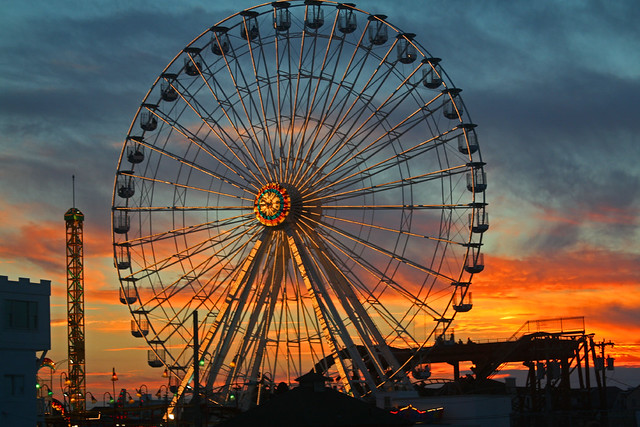
The Wonderland Pier Ferris wheel may soon be demolished. The wall beneath the raised deck is collapsing, the deck is buckling, and we are being told that years of salt air and welded repairs have made it impossible to safely dismantle and rebuild the wheel somewhere else.
For a lot of people, that wheel is Ocean City.
They remember seeing it from the bridge and knowing they had arrived. They remember looking up at it as children, then taking their own children for a ride years later. They remember summer nights on the Boardwalk, tickets in one hand and something sticky in the other. They remember the lights, the height, the ocean in the distance and that brief pause at the top while more riders climbed aboard below.
I understand why losing it hurts. I have my own memories of Wonderland. I also installed its wireless infrastructure and worked on its systems for a couple of years when I was running Wright’s Computer Service. I knew the place from both sides: as part of the Ocean City I grew up in and as a working property full of equipment, wiring, employees and everyday problems.
But when I look at that rusting wheel now, I do not see only childhood. I see a town that ignored change for decades and then became furious when change finally reached something everybody recognized.
## The Ferris Wheel Is Not Where This Started
I moved to Ocean City in 1984 when I was 12 years old. I left in 2024, after forty years. I grew up there, worked there, raised my children there and built a business there. Ocean City was not a week at the beach for me. It was home.
That is why I find some of the public mourning over Wonderland difficult to listen to.
Again and again, I read comments in Ocean City groups saying the town is slowly dying because Wonderland closed. People write as if the sale of that property, the possible hotel and the threatened Ferris wheel were the moment everything changed.
My question is: Where were you 25 or 30 years ago?
In the early 1990s, a house went up on the north, bayside corner of 35th Street and West Avenue. Anyone who pays attention can still see that the property sits farther out toward the sidewalk than the other houses along that side of the street. It caused a problem at the time. I do not know every meeting that took place or every conversation behind closed doors. We did not have Facebook groups documenting every complaint, and whatever opposition existed may have extended only a block or two.
What I know is that the house remained.
That is how change often happened in Ocean City. One questionable exception. One oversized building. One old single-family home replaced by two large rental units. One zoning argument that most of the island ignored because it was happening in somebody else’s neighborhood.
Then the exception became the pattern.
People talk about protecting the character of Ocean City now, but its character was not lost in one dramatic vote. It was traded away property by property, block by block, while most people were looking somewhere else.
## Outrage Has a Very Small Radius
The proposed Verizon cell tower near the airport is a perfect example of how Ocean City responds to change.
When I drive into town at 34th Street and turn onto Bay Avenue, the first few blocks are packed with “No Cell Tower” signs. There seem to be dozens of them. Then, almost as suddenly as they begin, they stop.
That tells the whole story.
The people closest to the tower are organized because they believe it will affect their homes, their views, their health, their property values or their daily lives. A few blocks away, the urgency disappears. The tower did not get shorter. The issue did not become more or less right. It simply moved outside somebody’s personal radius of concern.
That same radius appears everywhere in town. If a development blocks someone else’s view, crowds someone else’s street or changes someone else’s neighborhood, it is progress. When it reaches your block, it becomes greed, corruption and the destruction of Ocean City.
## Environmentalism, When Convenient
The offshore-wind debate exposed the same contradiction.
We heard that wind turbines would kill whales, destroy sea life and fail whenever the wind stopped blowing. Some people spoke as if the turbines would not produce electricity at all. Federal scientific agencies said there was no evidence linking offshore-wind survey work to the whale deaths being blamed on it, but the claims kept circulating because they were useful.
At the same time, Ocean City continued dredging waterways and pumping offshore sand onto its beaches. Those projects physically disturb marine environments too. Beach replenishment is defended because it protects property, preserves the beach and supports the tourism economy. It benefits the island financially, so the environmental cost is treated as manageable.
Offshore wind offered no immediate check to a homeowner and might change the view, so suddenly every sea creature became sacred.
I am not saying projects should escape environmental review. They should not. I am saying concern loses credibility when it appears only after money, scenery or property values are threatened.
## Now It Is Their Morning Sun
The hotel proposed for the Wonderland site has produced the loudest version of this selective concern.
Residents behind the property worry about losing the morning sun over the ocean. They worry about parking, traffic, noise, crowds and the size of the building. Those are legitimate concerns. A large hotel would change their immediate surroundings, and they have every right to fight it.
But I also know what it feels like to watch the place around your home change until you no longer recognize your own life in it.
I watched single homes disappear. I watched neighborhoods become investments. I watched familiar year-round families give way to properties built to hold as many summer renters as possible. I watched the town become less of a community and more of a product.
Where was this island-wide outrage then?
Where were the packed meetings and desperate speeches when ordinary residents lost sunlight, parking, quiet streets and neighbors? Where was the concern when year-round homes were torn down and replaced with buildings designed mainly to maximize rental income?
Most of the people now warning that a hotel will change Ocean City accepted years of change because it was profitable, distant or easy to ignore.
Part of me hopes the hotel is built. That is not the kindest part of me, but it is honest. I hope the people who dismissed everyone else’s losses finally understand what it feels like. I hope they become tired of the noise, the traffic, the blocked sun and the crowds. I hope they get so sick of it that they move away.
I did.
## The Town I Left
I did not leave a place I hated. That would have been easier.
I left the town where I grew up. I left the town where I raised my children. I left neighbors, friends, families, festivals and decades of good times. I remember when year-round residents looked forward to summer visitors. They were not simply customers or occupants rotating through a rental property. Many were families who came back year after year. Local families and visiting families knew one another across generations. There were dinners by the pool, familiar faces returning each season and a genuine sense that summer guests were joining the town for a while.
That Ocean City was not perfect. Memory has a way of sanding down rough edges, and I will not pretend every old house was beautiful, every local decision was honest or every summer was carefree. But it was a community in a way the current version often is not.
The loss happened slowly enough that people could deny it. There was never one morning when everybody woke up and the old Ocean City was gone. It happened through individual decisions that seemed small, private or profitable at the time.
That is why the collapsing wall beneath Wonderland feels so symbolic. The visible collapse came after years of deterioration underneath. By the time everyone could see it, the damage was already there.
The Ferris wheel is the same. It stood above the Boardwalk long enough for people to believe it would always be there. Now the bolts cannot simply be loosened. The welded repairs cannot be undone. Saving it is no longer a matter of wanting it badly enough.
There is a lesson in that, although I doubt Ocean City will learn it.
## Let It Fall
I know people will call the Ferris wheel historic. They will say it belongs to every child who ever saw its lights from the Boardwalk or rode to the top with a parent. They will be right.
But memories do not live inside steel. Tearing down the wheel cannot erase a first ride, a family vacation or the sight of Wonderland glowing on a summer night. Those memories belong to the people who made them.
The structure itself has become something else: a monument to how Ocean City handles loss. Ignore the warning signs. Allow exceptions when they benefit the right people. Fight fiercely only when the consequences arrive at your own property line. Then, when a familiar landmark finally begins to collapse, act as though the collapse started yesterday.
I loved Ocean City enough to spend forty years there. I loved it enough to raise my family there, run a business there and believe for a long time that I would always call it home.
Then I watched it become a place I could no longer live.
So yes, I understand the sadness. I understand what that old, wrecked Ferris wheel means to people. But I cannot pretend its demolition is the death of the Ocean City I knew.
That Ocean City was already gone.
And God willing, soon the fucking Ferris wheel will be gone too, so nobody can keep pointing at it and pretending it was the only thing we lost.
—
Ferris wheel to be demolished — Ocean City Sentinel
Wonderland Pier hotel debate — WHYY
Ocean City beach replenishment project — U.S. Army Corps of Engineers